
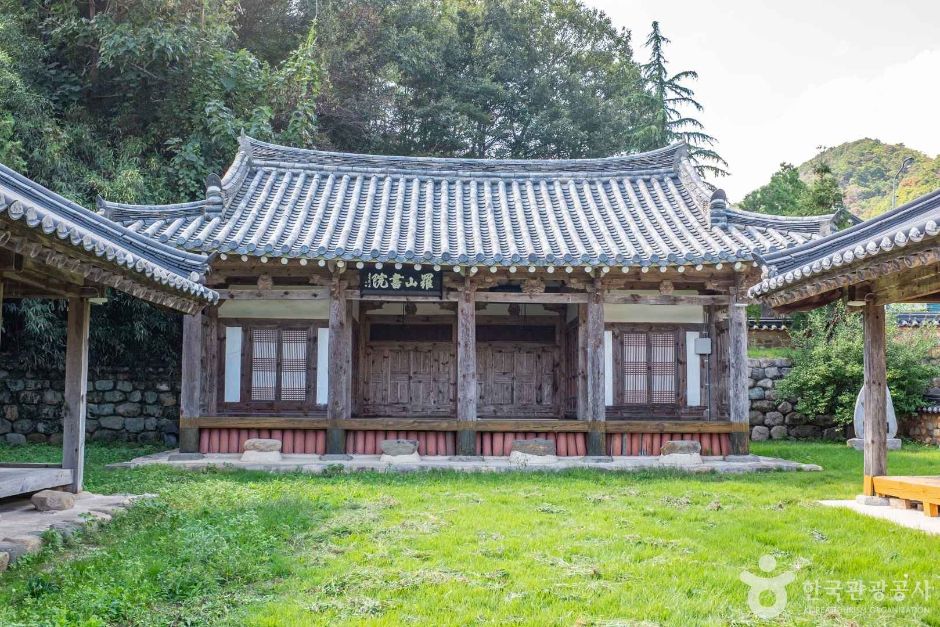
Nasan Seowon
Gyeongsangbuk-do Gyeongju-si 양남면 나산1길 27
Open in mapAbout this place
Nasan Seowon, located in the main village of Nasan-ri, Yangnam-myeon, Gyeongju-si, is a place that honors the early-Joseon civil official Baekchon Kim Mun-gi, and it is also called Nasansa. This academy, where the descendants of Master Kim Mun-gi and Master Kim Je-hak, the first settler of Nasan-ri, hold memorial rites each year, is located at the southernmost tip of Gyeongju and is the only seowon established in the coastal area. Walking from the village hall at the entrance of Nasan-ri to the academy, one can feel the atmosphere of a yangban (aristocratic) village of the Andong Jang clan. Nasan Seowon follows the typical seowon architectural style of the Joseon period, comprising, on a site of 800 pyeong, a shrine of 3 kan, a lecture hall of 4 kan, an eastern hall of 3 kan, a western hall of 3 kan, a jeonsacheong (ritual preparation hall) of 3 kan, one outer three-gate, two inner three-gates, and a caretaker's house. It was built in 1780 (the 4th year of King Jeongjo), demolished in 1868 (the 5th year of King Gojong) during the order to abolish seowon, and reconstructed in 1936. Memorial rites are held each year on the middle hae day of the third month. Kim Mun-gi was born in 1399 (the 1st year of King Jeongjong); his ancestral seat was Gimnyeong and his courtesy name was Yeogong. In 1426 (the 8th year of King Sejong) he passed the singnyeon civil service examination and served in posts such as Yemun-gwan Geomyeol, Jeongeon, and Minister of Works (Gongjo Panseo). In 1456 (the 2nd year of King Sejo) he took part in the attempt to restore King Danjong led by Seong Sam-mun, Bak Paeng-nyeon, and others; it was discovered and he was executed. In 1778 (the 2nd year of King Jeongjo) he was posthumously granted the rank of Uijeongbu Jwachanseong, and in 1791 he was enshrined at the Chungsindan (Altar of Loyal Subjects) of Jangneung, the tomb of King Danjong.