
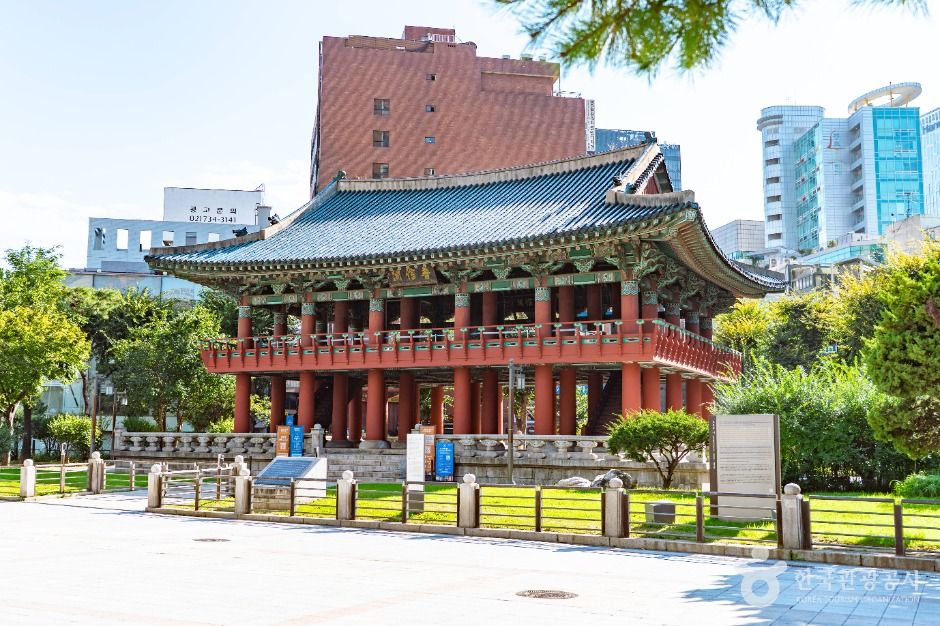
Site of Bosingak Bell Pavilion
Seoul Jongno-gu 종로 54
Open in mapAbout this place
Bosingak-teo is the site where Bosingak, a bell tower that announced the time inside and outside the capital fortress, once stood. Bosingak is also called Jonggak, and the name comes from the royal plaque 'Bosingak' bestowed in the 32nd year of King Gojong of Joseon (1895). First built in the 4th year of King Taejo (1395), it burned down four times and was rebuilt eight times. The current building was constructed by the Seoul city government in August 1979 as a two-story pavilion of five bays east-west and five bays north-south. The Bosingak Bell, Treasure No. 2, was cast in the 14th year of King Sejo of Joseon (1468) and kept at Wongaksa Temple; after the temple was closed, it was moved to the present Bosingak site in the 11th year of Gwanghaegun (1619). The bell was rung 33 times at 4 a.m. and 28 times at 7 p.m. to open and close the gates of the capital and announce the hours of the day. Over the long years, cracks formed in its body so it could no longer be struck, and it is now preserved in a bell pavilion built at the National Museum of Korea. The bell currently hanging in the pavilion was newly cast in 1985 with donations from the public and was first rung on Liberation Day that year. Every December 31, traffic is controlled around Bosingak and the area fills with people who gather to enjoy the bell-ringing ceremony welcoming the new year.