
Jinwolsa (Yeongju)
Gyeongsangbuk-do Yeongju-si 평은면 용혈리 1106
Open in mapAbout this place
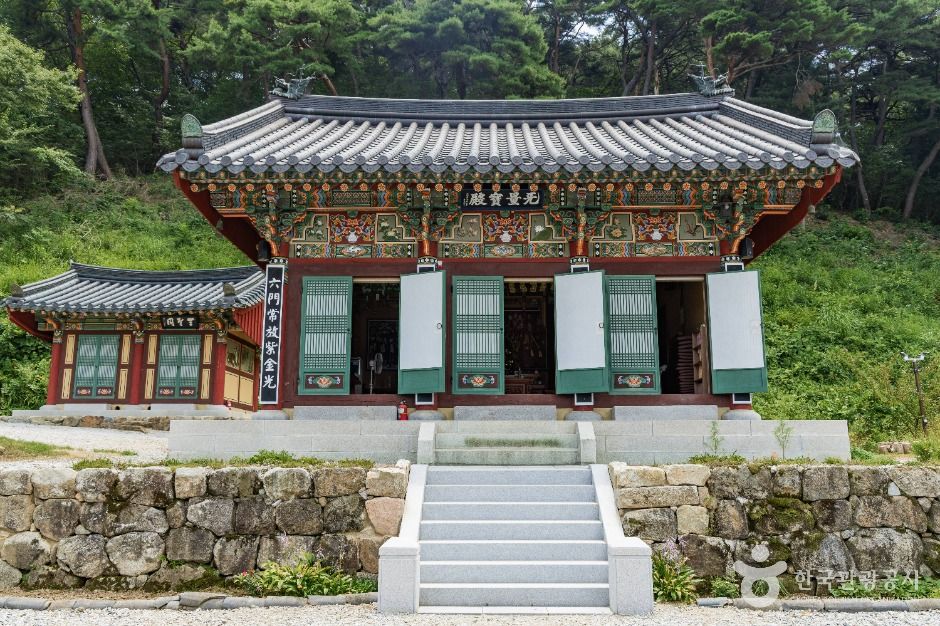
Jinwolsa, situated on the slopes of Hakgasan Mountain in Yongheol-ri, Pyeongeun-myeon, Yeongju, is a thousand-year-old temple. It stands on the highest ground among the temples of this region, facing the distant peaks of Sobaeksan Mountain to the northwest, with the Naeseongcheon Stream winding below the temple. The name Jinwol is closely tied to the local place name. Hakgasan Jinwolsa lies in the border area between Yeongju and Andong; although the site where the temple now stands belongs to Yeongju, its home village is said to be Woljeon-dong in Andong. The terrain of this village forms a highland basin, and where Dongsanma is located there is a half-moon-shaped hill; around that hill the fields are terraced like a half-moon, and so it came to be called Dalbat (Moon Field). The temple's name is said to derive from this village, becoming Jinwolsa. Jinwolsa is said to have been founded by Master Uisang, but no trace of the old buildings can be found; today the Muryangbojeon Hall, the Hyangnojeon Hall, the Simwollu Pavilion, and the monks' quarters built like an ordinary house catch the eye. *Founding background and history* Jinwolsa is a branch temple of Gounsa, the head temple of the 16th diocese of the Jogye Order of Korean Buddhism. It is said to have been founded by Master Uisang during the reign of King Munmu of Silla (r. 661–681), though its exact origin is unknown. Its history from then until the mid-Joseon period has not been transmitted. In 1720 (46th year of King Sukjong of Joseon), Seolsin and Gyewon rebuilt the Muryangbojeon (Geungnakjeon) Hall, changing the temple's principal Buddha from Ksitigarbha Bodhisattva to the Amitabha triad and enshrining it anew, and also newly built the Nojeon. In 1797 (21st year of King Jeongjo), Gyemun repaired it, and in 1807 (7th year of King Sunjo), Siim and Jeongsin repaired it. Huimin repaired it in 1891 and Bojeong in 1919, bringing it to the present day. The surviving buildings include the Muryangbojeon, Samseonggak, Simwollu, Hyangnojeon, and monks' quarters. No particular relics have been transmitted.