
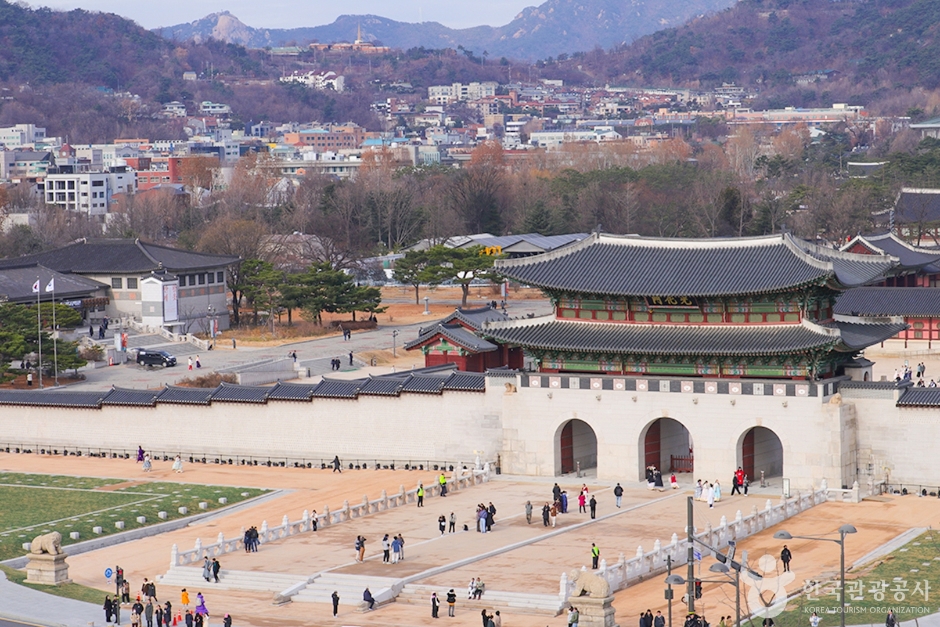
Gwanghwamun Gate
Seoul Jongno-gu 사직로 161
Open in mapAbout this place
Gwanghwamun is the south gate of Gyeongbokgung Palace and the main gate of the palace wall. Gwanghwamun was the main gate through which the king passed, but because it was the main gate of Gyeongbokgung, the primary palace of Joseon, it was far more grand and splendid in scale and formality than the main gates of other palaces. Gwanghwamun also had Dongsipjagak and Seosipjagak at the eastern and western ends of its walls respectively, making it the only one among Joseon's five great palaces to possess the form of a fortified palace gate. Gwanghwamun consists of three arched openings in the stone-terrace base that supports the two-story gate tower; the king passed through the central arch, while the crown prince and officials passed through the left and right arches. A bell was hung in the gate tower and used to announce the hours. Thus, the fact that Gyeongbokgung was the primary palace of the Joseon dynasty can also be confirmed from the form of its gates, including Gwanghwamun. Whereas the gates of other palaces were built on low platforms, the gates of Gyeongbokgung were raised on high stone terraces with arched openings in the center, taking on the appearance of fortress gates. Among these, Gwanghwamun has as many as three arched openings, presenting the most dignified appearance and clearly revealing that it is the main gate of the primary palace. At the time of Gyeongbokgung's founding it had no special name and was called 'Omun' (Noon Gate) according to palace convention; in the 3rd year of Taejo (1395) Jeong Do-jeon changed the name to 'Jeongmun' (Main Gate), but in the 8th year of Sejong (1426), when Gyeongbokgung was repaired, the Hall of Worthies proposed the name 'Gwanghwamun' (光化門), and thus it acquired its present name. Originally, when the Japanese Government-General building was constructed, Gwanghwamun was moved to the north of Geonchunmun, the eastern gate of the palace wall, but during the Korean War it was bombed, its gate tower shattered and its stone terrace riddled with shell marks. Amid this, Gwanghwamun was rebuilt into its present form under the Park Chung-hee government in 1968; the destroyed gate tower was rebuilt and Gwanghwamun was moved to its present site. However, the newly rebuilt Gwanghwamun was made of reinforced concrete, and at the time of reconstruction its axis was aligned not with the central axis of Gyeongbokgung but with the axis of the former Japanese Government-General building, then used as the Central Government Complex, so that it ended up skewed by about 3.5 degrees from its original axis. Not only that, it was set back about 14.5 meters from the original site of Gwanghwamun, coming to stand at its present location. To restore Gwanghwamun, which had lost its original form in this way, demolition work began in 2006, and after 3 years and 8 months of restoration work it was completed on August 15, 2010. A massive base was made of granite, and upon it a two-story gate tower was placed, affording good distant views as well as displaying the dignity befitting a palace main gate. The three arched entrances in the base proclaim the dignity of Gyeongbokgung as the principal palace of Joseon. On top of the stone base a low wall was set with 'jeondol'—bricks made by firing clay—and the eight-trigram patterns adorning it well reflect the character of Joseon-dynasty palaces.