
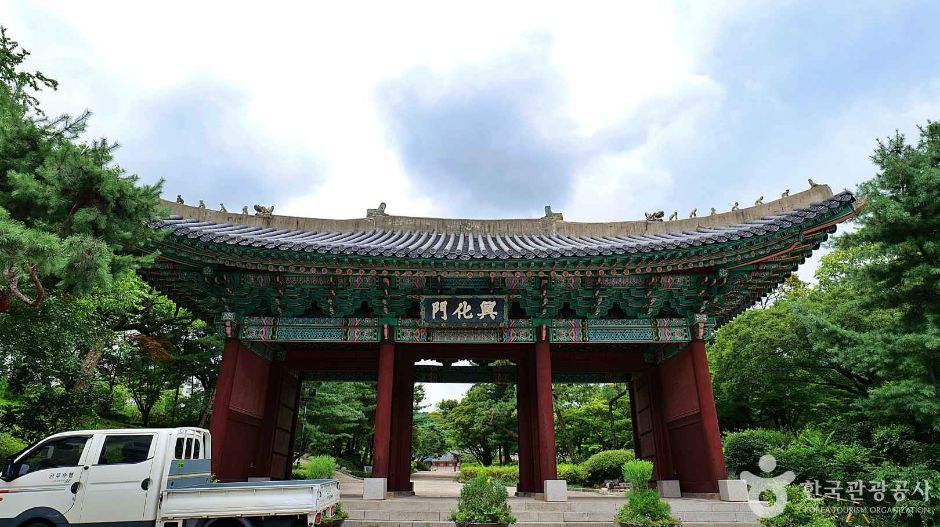
Heunghwamun Gate of Gyeonghuigung Palace
Seoul Jongno-gu 새문안로 55 (신문로2가)
Open in mapAbout this place
Heunghwamun is the main gate of Gyeonghuigung Palace. Originally there were five gates leading into Gyeonghuigung: besides the main gate Heunghwamun, there were Heungwonmun to the east, Sunguimun to the west, Gaeyangmun to the south, and Mudeokmun to the north. At its founding, Gyeonghuigung followed the system of Changgyeonggung and was built on a small scale, so the main gate too was erected as a single-story structure. The low hill near Gyeonghuigung was called 'Yajugae'; the name was given because the calligraphy on Heunghwamun's plaque was so masterful that it glowed even at night, its radiance illuminating the hill brightly. Heunghwamun was originally built east of the Geumcheongyo bridge, that is, at the site of today's Salvation Army Hall building, facing east toward Jongno. However, during the Japanese colonial period, as the road was widened in 1915, Heunghwamun was moved slightly back from its original location, and the gate's orientation was also changed to face south, parallel to the road. In 1932, when Bakmunsa, a temple dedicated to Ito Hirobumi, was built, Heunghwamun was removed to be used as its main gate. After liberation, Bakmunsa was abolished, and the Yeongbingwan guesthouse and the Shilla Hotel were built on the site, where the gate was also used as their main gate. In 1988, as part of the Gyeonghuigung restoration project, the Seoul metropolitan government moved Heunghwamun to the Gyeonghuigung grounds; by relocating and restoring it at its present site, where the old Gaeyangmun once stood, it sought to revive the gate's historical significance as a palace main gate.