
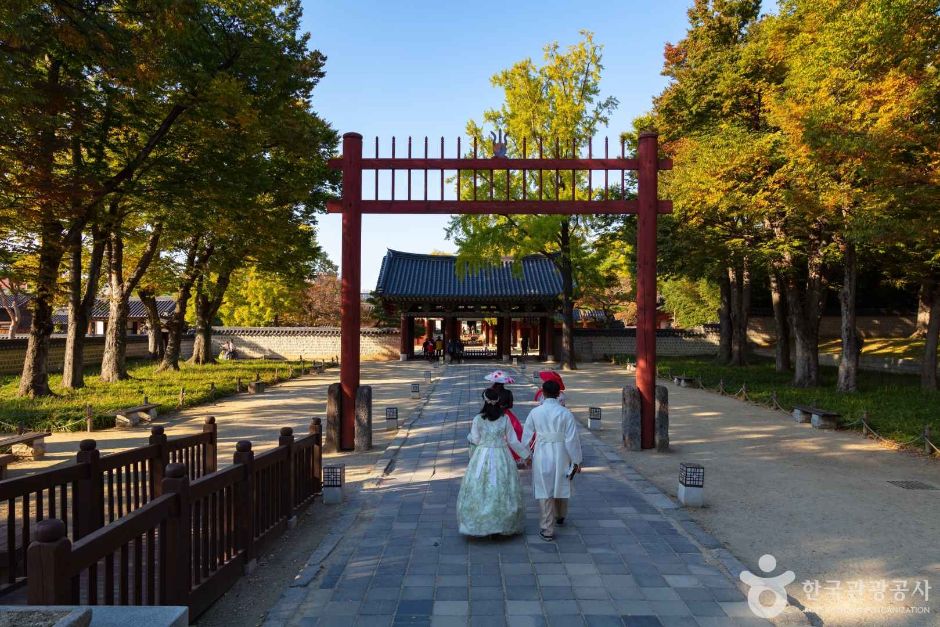
Gyeonggijeon Shrine
44 Taejo-ro, Pungnam-dong 3-ga, Wansan-gu, Jeonju-si, Jeonbuk
Open in mapAbout this place
Gyeonggijeon was built in the 10th year of King Taejong's reign (1410) to enshrine and offer rites to the royal portrait (eonjin) of King Taejo, the founder of the Joseon dynasty. The places in Jeonju, Gyeongju, and Pyongyang where royal portraits were enshrined were originally called 'Eoyongjeon'; in the 12th year of Taejong (1412) they were renamed 'Taejo Jinjeon,' and in the 24th year of Sejong (1442) each was given a distinct name: Jeonju's became Gyeonggijeon, Gyeongju's Jipgyeongjeon, and Pyongyang's Yeongsung-jeon. Gyeonggijeon was burned during the Jeongyu War in the 30th year of King Seonjo's reign (1597) but rebuilt in the 6th year of King Gwanghae's reign (1614). The complex comprises a horse-dismounting marker (hamabi) denoting its sacred status, a red-spiked gate (hongsalmun), the outer spirit gate, the inner spirit gate, and the main hall (jeongjeon) housing the royal portrait. As a royal shrine, the gates are called 'spirit gates' (sinmun); when passing through the three gates inside the hongsalmun, visitors must enter from the east (right) and exit from the west (left) — the 'donginseochul' rule — because the center pathway (sindo) is for the passage of Taejo's spirit. Gyeonggijeon is of great historical importance because it housed the Jeonju Royal Archive (Jeonju Sago) along with the royal portrait of Taejo; the archive was established here in 1439 (the 21st year of King Sejong). Within the grounds are also the Gyeonggijeon main hall (tangible cultural heritage) and Jogyeongmyo (tangible cultural heritage), which enshrines the memorial tablets of Yi Han, the 22nd-generation ancestor of Taejo and founding ancestor of the Jeonju Yi clan, and his wife. Notably, the Royal Portrait Museum displaying the royal portraits of the Joseon dynasty — including the national treasure portrait of Taejo — is also located here. Gyeonggijeon has long been beloved by tourists and citizens alike for its antique charm amidst the city and its lush trees.