
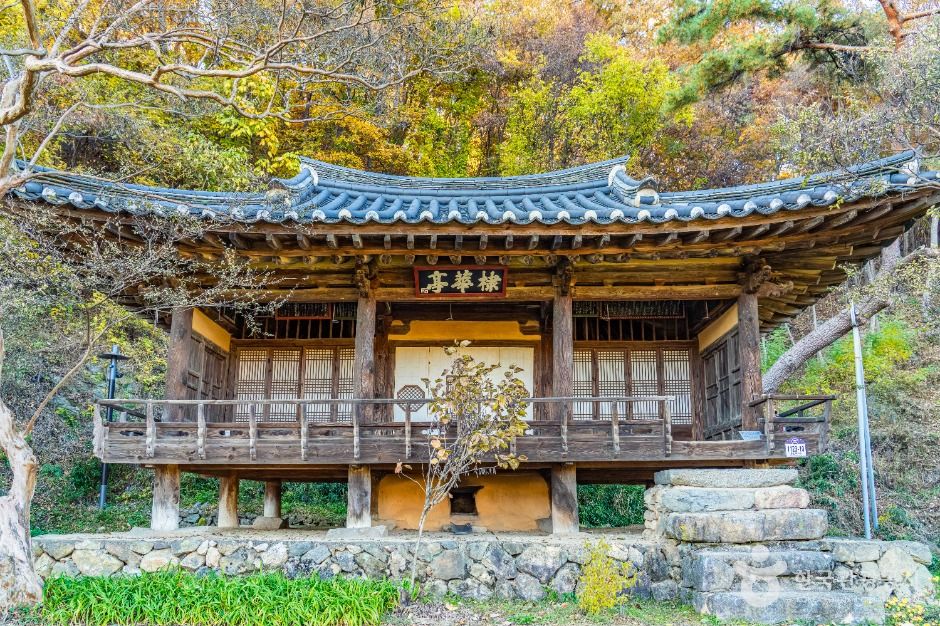
Chehwajeong Pavilion, Andong
Gyeongsangbuk-do Andong-si 풍산읍 풍산태사로 1123-10
Open in mapAbout this place
Chehwajeong is a pavilion built in 1761 by Yi Min-jeok, a scholar of the late Joseon period. In the pavilion's name, "chehwa" is a shortened form of "sangchejihwa," meaning brotherly love and harmony among siblings; the phrase is said to derive from the Classic of Poetry (Shijing). In his later years, Yi Min-jeok lived here with his eldest brother Yi Min-jeong, deepening their brotherly bond. Centered on an ondol (heated-floor) room, it has wooden-floored rooms on either side, with a veranda and railing at the front. Between the ondol room and the flanking floored rooms, lift-up doors were installed so the space could be enlarged. It was designed so that, by raising the doors of the central ondol room, the whole interior could be fully opened. In the middle of the ondol room's doors, an additional small window called a "nunkkopjaegi-chang" was made so one could look outside without opening the door. The signboard hung at the front was written by Yu Jeong-won, a scholar from Andong who had been the tutor of Crown Prince Sado. Inside the pavilion hangs a signboard reading "Damnakjae," written by Kim Hong-do, one of the greatest painters and calligraphers of Joseon. It conveys the idea that only when brotherly affection is firm can one truly fulfill one's duty to one's parents. In front of Chehwajeong a square pond was dug, and in the middle of the pond three round islands were formed. This represents the traditional East Asian cosmology that "heaven is round and the earth is square," and the three islands symbolize the Three Sacred Mountains where immortals are said to dwell. The plan form of Chehwajeong and its distinctive arrangement of doors and windows harmonize well with the pond, making it a valuable resource for the study of traditional landscape gardening.