
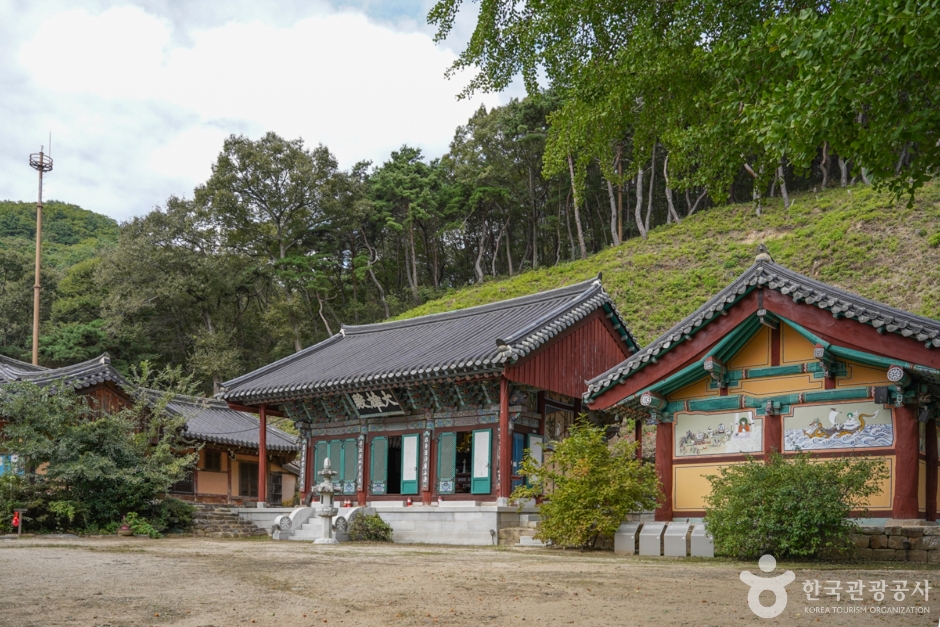
Sudasa Temple (Gumi)
183 Sudasa-gil, Mueul-myeon, Gumi, North Gyeongsang Province
Open in mapAbout this place
Sudasa, located on Yeonaksan, is presumed to have begun as a temple of the Hwaeom order during the Goryeo period. Its origin traces back to when someone saw a single white lotus blooming on Mibong, the highest peak of Yeonaksan, and named the temple Yeonhwasa. In 1185, Great Master Gagwon rebuilt it and changed its name to Seongamsa, and in 1572, after Yujeong rebuilt it, the name was changed to Sudasa. When the Imjin War broke out in 1592, more than ten thousand monk-soldiers gathered here and held a dharma assembly for the loyalty and defense of the nation. In 1704 the temple burned down, leaving only the Daeungjeon, Siwangjeon, and Geungnakdang. Nevertheless, it is said to have been a temple whose abbotship was passed down through dharma-heirs from Hwaong to Haeyu and Hagui. Hagui established the Jangnyeon Chunchu Suryukjibo and also received the support of Grand Prince Hyoryeong. Among the surviving buildings are the Daeungjeon, Myeongbujeon, Sansingak, and monks' quarters. Of these, the Daeungjeon is a gable-roofed building measuring three bays across the front and three bays on the side, housing a wooden seated Amitabha Buddha inside. This statue is one of the triad created by Gagwon in 1185. The Sudasa Myeongbujeon is a gable-roofed building three bays across the front and two bays on the side. After being designated Gyeongsangbuk-do Tangible Cultural Heritage No. 139 on December 18, 1979, it was repaired twice, in 1982 and 1992. Among its relics are the Yeongsanhoesangdo, a late-Joseon hanging painting of Shakyamuni Buddha, a bronze bell cast in 1772, and a three-story stone pagoda.