
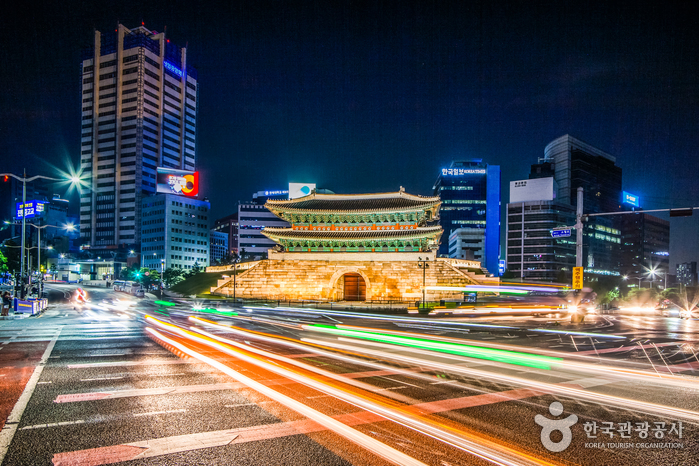
Sungnyemun Gate (Namdaemun)
Seoul Jung-gu 세종대로 40
Open in mapAbout this place
Sungnyemun is the southern main gate of the Joseon capital's fortress wall, located in Namdaemunno 4-ga, Jung-gu, Seoul; as it stands to the south among the four main gates, it is also called Namdaemun (Great South Gate). A symbol of Seoul and the oldest surviving wooden building in the city, it was designated a National Treasure on December 20, 1962. Among Seoul's four main gates, it is the largest in scale and is distinctive for having its signboard inscription written vertically. It was first built in 1396 (5th year of King Taejo of Joseon) and rebuilt in February 1398. A large-scale repair took place in 1479 (10th year of King Seongjong), and it served as a gate of Hanseong for many long years without suffering damage even during the Imjin War and the Manchu invasion of 1636. In 1907, due to the Japanese order to disband the army, it became a site of battle; that same year, during the visit of the Japanese crown prince to Korea, it also endured the tragic history of having the fortress wall connected to Sungnyemun torn down under the pretext that the crown prince could not pass beneath the gate tower with his head bowed. In 2006, the gate, which had been left standing alone without any connected wall, was restored to recreate its original appearance. On February 10, 2008, a fire burned part of the first-story gate tower and destroyed the second-story gate tower. After salvage work and various studies for restoration, a restoration ceremony was held on May 4, 2013, and the gate was reopened to the public. It is a two-story pavilion-type building, five bays across the front and two bays deep, built above a rainbow-shaped arched gateway (hongyemun) set in the middle of a high stone rampart. When viewed from the front, the roof has a trapezoidal shape; such a roof is called a hip roof (ujingak roof). The bracket sets, ornately assembled at the tops of the columns to support the roof eaves, are placed not only on the columns but also between them, in the multi-bracket (dapo) style; their form is not excessively curved and their construction is sturdy, well showing the characteristics of the early Joseon period. According to the 'Jibong yuseol,' Grand Prince Yangnyeong, the eldest son of Taejong, is said to have written the signboard of Sungnyemun.